

Two Conditions That Share a Waiting Room
If you have lipedema, there’s a good chance someone, at some point, has told you that you have lymphedema. Maybe it was a doctor glancing at your legs or maybe it was a well-meaning friend who found an article online. The two names are nearly identical, both can involve bigger legs, and both are poorly understood by most of the medical system. The confusion is understandable but problematic.
These are two different conditions with different causes, different warning signs, and different management paths. And while there are some crossovers, a woman treated for the wrong condition can spend years doing things that don’t help, while the things that would help go untried.
So let’s put them side by side, the way a specialist would, and look at what actually separates them.
What Lymphedema Actually Is
Lymphedema is a fluid problem. Your lymphatic system is a network of vessels that collects excess fluid from your tissues and returns it to circulation. When that system is damaged or overwhelmed, fluid backs up and the affected limb swells. The damage can come from surgery, radiation, infection, or injury, and in some cases people are born with a lymphatic system that doesn’t work as it should.
Lipedema, by contrast, is primarily a fat and connective tissue disorder. The tissue itself is different: it grows in a distinctive pattern, it hurts, it bruises easily, and it does not respond to diet the way ordinary fat does. Fluid can be part of the picture, but it is not the starting point. In fact a fact biopsy will show the marked difference between lipedema fat and regular fat.
A simple way to hold the difference: lymphedema is a plumbing problem, lipedema is a tissue problem. The two can look alike from across the room, but up close they behave very differently.
The populations differ too. Secondary lymphedema in the United States most often follows cancer treatment, particularly breast cancer surgery involving lymph node removal, which is why so much lymphedema care lives inside oncology programs. Lipedema, by contrast, arrives almost exclusively in women and typically announces itself at hormonal transitions like puberty or pregnancy, often with a family history running quietly through the generations. Where the swelling came from is often the fastest clue to what it is.
The Telltale Signs Doctors Look For
A clinician who knows both conditions checks a few specific things, and you can look at most of them yourself.
Your feet. Lipedema almost always spares the feet. The swelling stops at the ankle, often with a visible cuff or “bracelet” of tissue. Lymphedema usually involves the foot, including the toes.
The Stemmer’s sign. Try to pinch and lift the skin at the base of your second toe. If the skin lifts easily, that’s a negative Stemmer’s sign, which points away from lymphedema. Thickened skin you cannot pinch suggests lymphedema.
Symmetry. Lipedema is remarkably symmetrical: both legs, matching pattern. Lymphedema is often one-sided or clearly worse on one side.
Pain and bruising. Lipedema tissue is tender to pressure and bruises easily. Lymphedema swelling is usually painless in its early stages.
Pitting. Press a thumb firmly into the swollen area for a few seconds. Early lymphedema often leaves a pit that slowly refills. Lipedema tissue generally does not pit in the early stages.
One more pattern worth watching: how the swelling responds to elevation and rest. Lymphedema fluid often improves noticeably overnight or with the legs raised, especially early on. Lipedema tissue barely changes with elevation, because tissue is not fluid and gravity was never the main problem. It is helpful for lipedema, but it is going to solve a secondary and not the primary issue.
No single sign will settle it on its own, however, but self-checks are a great starting point rather than a complete answer. Bring what you notice to a clinician who understands both conditions, because a proper assessment looks at the whole pattern together.
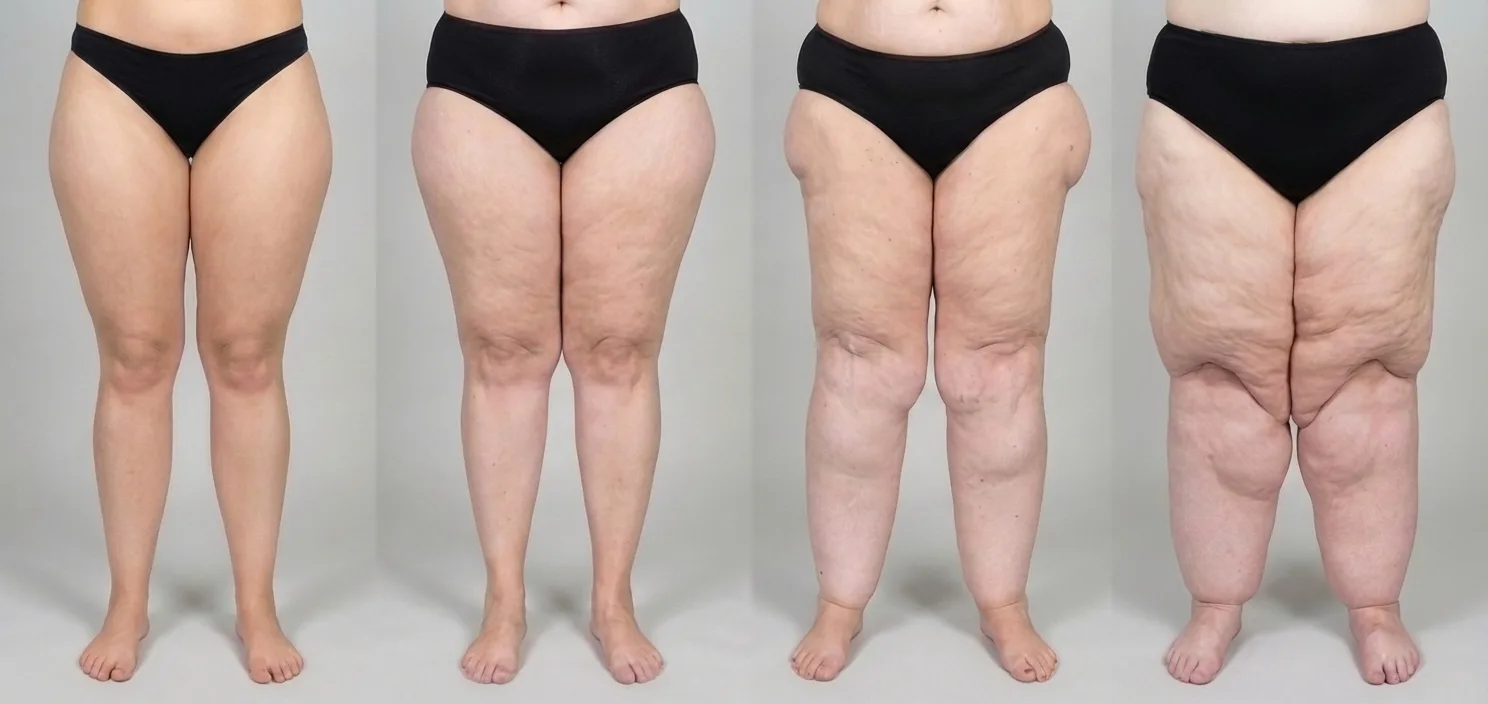
Lipedema in four different stages
When the Two Overlap: Lipo-Lymphedema
Here’s where it gets more complicated, and where the confusion becomes forgivable. Lipedema, when it progresses, can strain the lymphatic system it sits alongside. Although not clinically obvious, the lymphatic system quietly begins to malfunction even in early stages of lipedema. Enlarged, inflamed tissue makes it harder for lymphatic vessels to do their job, and over time some women develop a genuine secondary lymphedema on top of their lipedema. Clinicians call this lipo-lymphedema.
When that happens, the tidy checklist above begins to blur. Feet that were always spared before, may begin to swell. Skin changes appear as the limb takes on features of both conditions at once.
This is one of the strongest arguments for early recognition and consistent management. Research suggests that supporting lymphatic flow through movement, compression, and manual lymphatic drainage may help reduce the load on the system before that overlap develops. We cover the daily lymphatic routine in more detail in our lymphatic drainage pillar post (see below), so go check that out for further investigation.
Why the Right Label Changes Your Treatment
If this were only a naming quibble, it wouldn’t deserve an article. But the label steers your treatment and that is vital for making life better.
Lymphedema management is built around moving fluid: complete decongestive therapy, bandaging, precise compression, meticulous skin care to prevent infections like cellulitis. Lipedema management is broader: anti-inflammatory nutrition, lymph-friendly movement, compression chosen for tissue comfort and support, and attention to hormones, sleep, and stress. There is real overlap between the two toolkits, but the emphasis, the goals, and the specialists involved are different.
The label also changes how your progress is judged. A woman with lipedema who is assessed as a lymphedema patient may be told her treatment is failing because the limb isn’t shrinking, when in reality her tissue was never going to behave like fluid. That kind of misread is discouraging, and it is avoidable.
There is also a practical stakes difference worth knowing. Lymphedema carries a real risk of cellulitis, a skin infection that can escalate quickly and needs prompt antibiotics. Women with lymphedema are taught to guard their skin, treat small cuts seriously, and act fast on spreading redness or fever. If lymphedema is part of your picture and nobody has had that conversation with you, that alone is reason to seek out a specialist.
If you’re unsure which condition you’re dealing with, or whether you’re dealing with both, ask directly for an assessment that considers lipedema and lymphedema side by side. Vascular medicine clinics, lymphedema therapists, and lipedema-aware physicians are the right doors to knock on. In uncertain cases, clinicians can order imaging such as lymphoscintigraphy, which maps how well lymphatic fluid is actually moving, to separate the two conditions or confirm an overlap. You are allowed to name both conditions in the appointment and ask which one fits.
The mix-up between these two conditions has cost a lot of women a lot of years. Knowing the difference, and insisting that your care team knows it too, is one of the most practical pieces of self-advocacy available to you.
Further Reading
How to Tell the Difference Between Cellulite and Early-Stage Lipedema