
Health & Science · Investigative Report
The condition 1 in 9 women have, and almost no doctor is trained to treat
Your legs stopped responding to diet and exercise years ago. A biomedical engineer turned doctor can finally tell you why.
It isn't willpower. It isn't calories. Research now shows lipedema fat is biologically different tissue, driven by inflammation your diet was never designed to reach. Here is what the science actually says, and what Dr. Jonie Girouard does about it in her own body.

By Dr. Jonie Girouard, MD
Board-Certified Obesity & Family Medicine · Biomedical Engineer · Lipedema patient · 8 min read

You've been told a lie
Lipedema is not your fault.
Every diet, every exercise plan, every doctor who said “just eat less”. They were treating a condition you don't have. Lipedema is a distinct disorder of fat tissue, and it requires a completely different approach.
Here is what women in the clinic say, almost word for word, week after week:
“Everyone's talking about GLP-1s. But what actually works for lipedema?”
The honest answer has more to it than a simple yes or no. Lipedema fat itself is stubbornly resistant to typical weight-loss strategies. But many women also carry ordinary body fat, and that fat does respond. So GLP-1s are often used alongside lipedema care, never as a standalone fix, to address the excess weight and the inflammatory conditions that travel with it. They're one of seven treatment pillars, and not every woman responds. Once you understand that distinction, everything you've been through starts to make sense.
The science they never taught your doctor
Lipedema fat is different, right down to the genes.
When researchers compared lipedema fat tissue to ordinary fat, they didn't find a small difference. They found 4,391 genes expressed significantly differently between the two: a molecular signature favouring adipose hyperproliferation, fibrosis, and inflammation.1
That last word matters more than any other on this page. Inflammation is the engine. And it is the one part of this condition that what you eat can genuinely influence.
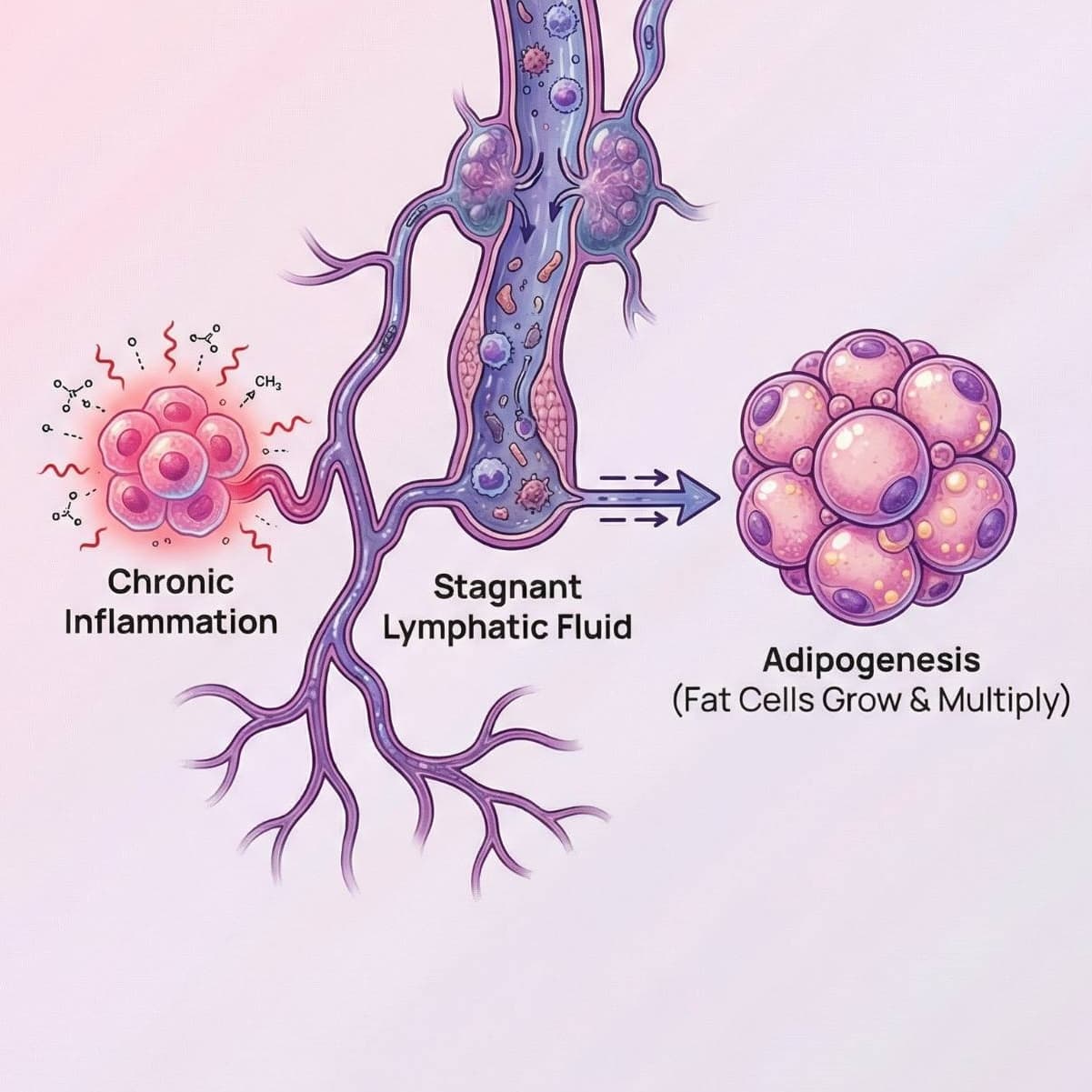
How progression happens: the adipogenesis cycle
Chronic inflammation
in the fat tissue
Stagnant lymphatic fluid
congestion in the limb
Fat cells grow & multiply
adipogenesis = progression
Traditional diets don't target inflammation. Some forms of exercise can increase it. Until you address both the inflammatory load and the lymphatic congestion, progression tends to continue, regardless of willpower.
Why your last diet couldn't win
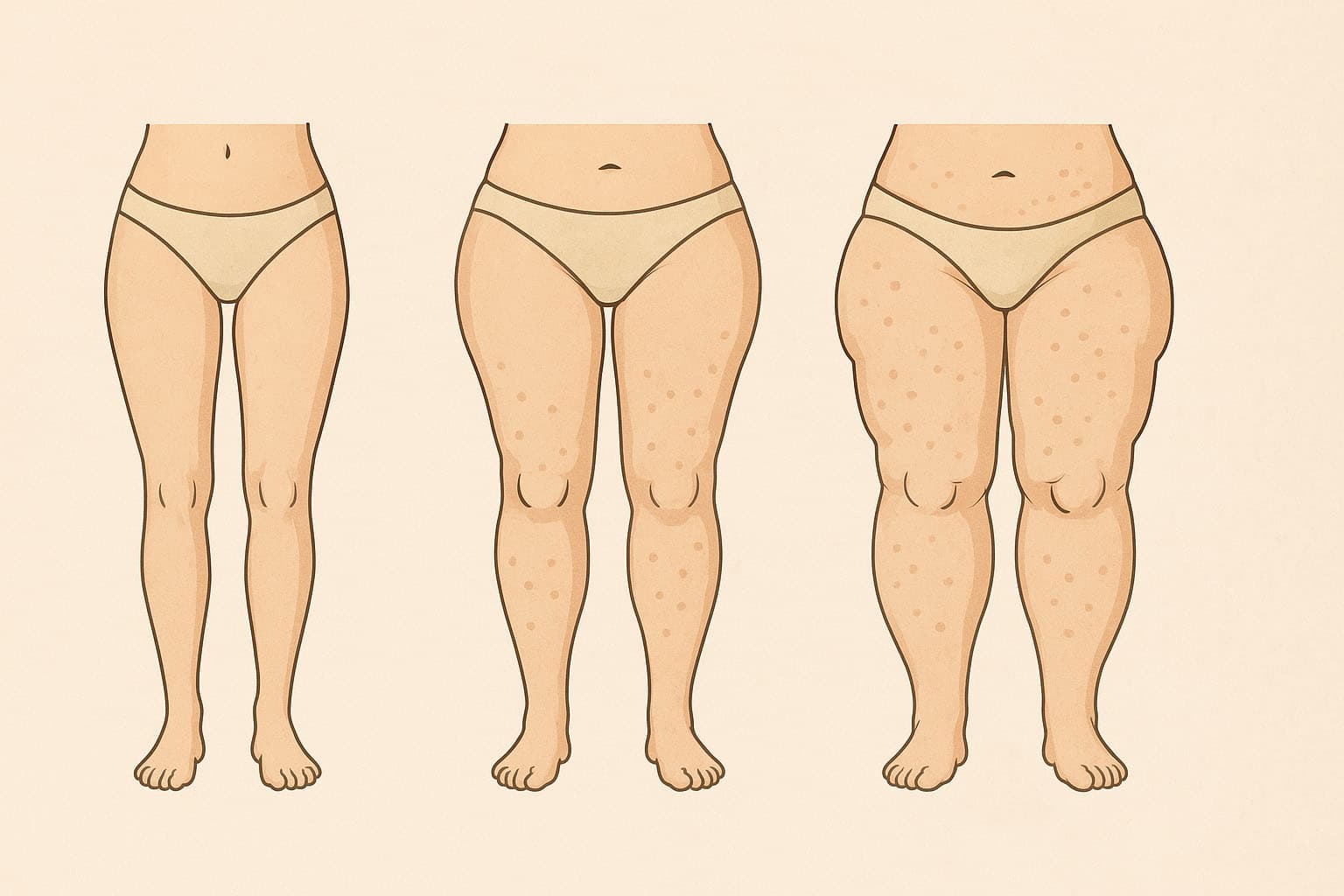
Lipedema fat vs. ordinary weight gain
They look similar on the outside. Underneath, they behave like two different conditions.
Distribution and diagnostic features per Keith et al. (2024)2 and Vyas et al. (2023)3; tissue biology per Ishaq et al. (2022).1
1 in 3
(28%)
of women with lipedema progress within 5 years: a limb-volume increase of at least 10%. The other two-thirds stay stable. And when it does progress, it's most closely tied to abdominal-fat gain, not age.4
What the numbers say
1 in 91
women are affected by lipedema
36%5
of adults take a medication linked to weight gain
85%
of women in clinic report a mental-health impact
30%
less muscle strength in the legs
Prevalence and progression figures per published literature1,4. Medication figure per Almazan et al. (2023)5, drawn from a general adult cohort rather than a lipedema-specific one. Mental-health and strength figures from Lipedema Clinic patient data.
Where you actually have leverage
If inflammation drives progression, then what you feed your body is not a side note. It's the lever.
You can't diet lipedema away. But you can influence the inflammatory load that tells your fat tissue to keep growing: through nutrition, lymphatic support, and targeted nutrients that address the deficiencies common in this condition.
This is exactly where most women get stuck. General wellness supplements aren't built for a lipedema body. So when Dr. Jonie went looking for products formulated around the inflammation, the lymphatic load, and the way this tissue actually behaves, she found nothing. So she built them.
“Every product in the Lipé range is something I take myself. These aren't endorsements. It's the protocol I use on my own body, and recommend to the women in my clinic.”
— Dr. Jonie Girouard, MD
These are educational tools and nutritional support, not a cure or a replacement for medical care. Always talk to your own doctor before changing your diet, medications, or supplement routine, especially if you're on GLP-1s, thyroid medication, or HRT.
The framework
A holistic, multidisciplinary approach
Nutrition and supplements are two of seven pillars that work together. No single one does it alone.
Support
Nutrition
Activity
Sleep & Stress
Lymphatic Drainage
Supplements
Diagnosis
Medical (Rx / Sx)
Not a supplement brand that found a doctor
A doctor who found a need in her own body.
For over 15 years Dr. Jonie has specialised in obesity medicine, including lipedema. Years into practice, she discovered she'd been living with undiagnosed lipedema herself, passed down from her father. If a specialist in this field didn't know, how many millions of women have no idea what's happening to their own bodies?
That question built everything that followed.
First
A biomedical engineer
She started in engineering, a way of thinking that never left her. Systems, mechanisms, and what's actually driving the thing in front of you.
Then
Medical school & family medicine
One pattern kept repeating: excess body weight sitting underneath so many chronic conditions, while the usual approach only reached the surface.
Next
Venous disease, then weight-loss medicine
Training in venous conditions, she met women with lipedema and lymphedema every single day, then moved into weight-loss medicine.
2012
Board Certified in Obesity Medicine
A full commitment to supporting women's health through prevention rather than damage control.
Since
Building awareness where there was none
Live events, GP training, and pushing for lipedema to be formally recognised. What began as a small social presence grew into the Lipedema Clinic and the Lipé range.
Formulated for women with lipedema, by one of them
The Lipé Range
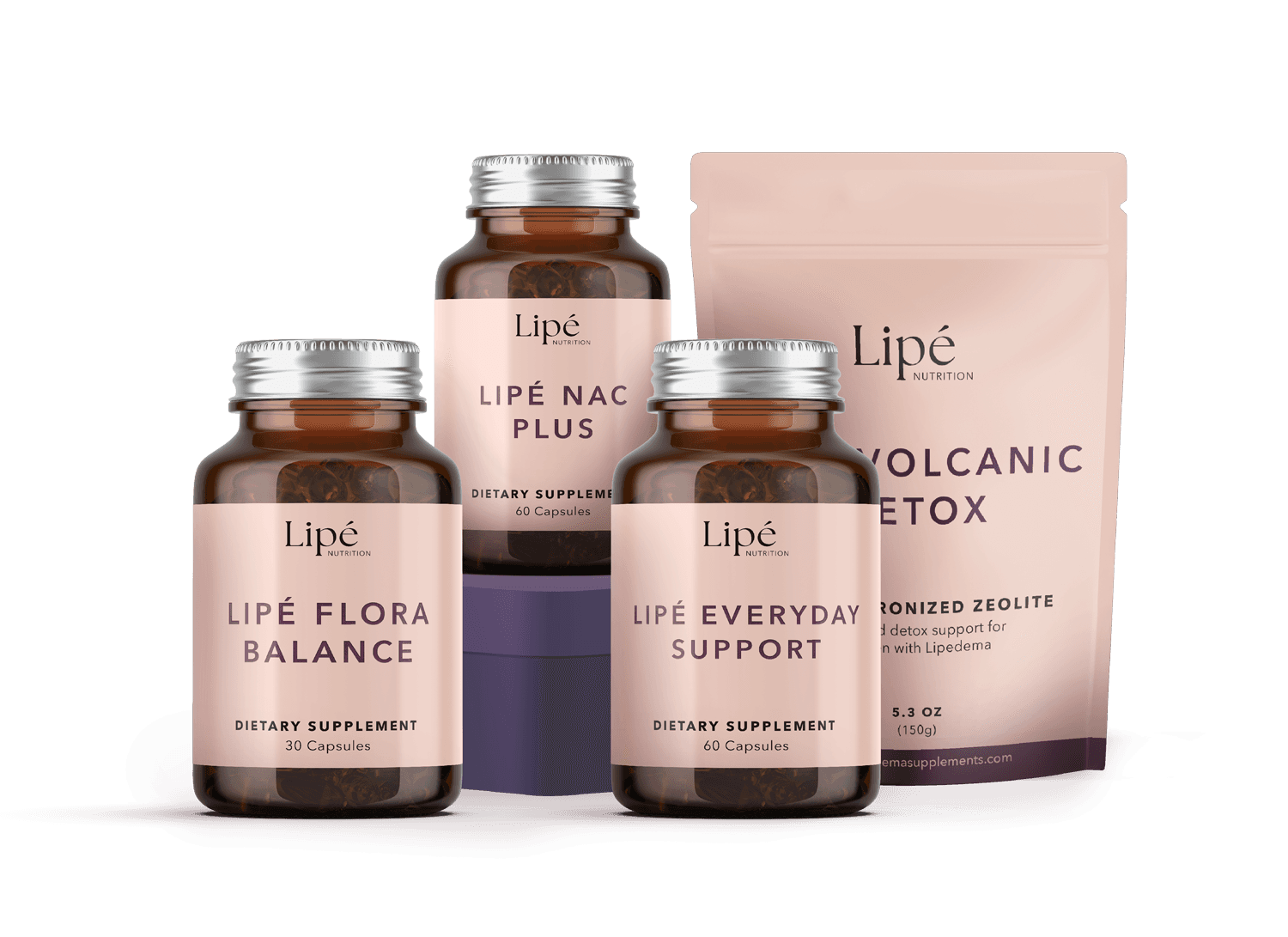
Targeted nutritional support built around the inflammation and lymphatic load of a lipedema body. The same protocol Dr. Jonie uses herself.
- Targets the inflammatory load that signals fat tissue to grow
- Supports lymphatic function and drainage
- Addresses nutritional deficiencies common in lipedema
- The exact protocol Dr. Jonie uses on herself
Free shipping · Money-back guarantee · Formulated by a lipedema specialist
Real stories from real women
Understanding changes everything
“For the first time in 20 years, I understand why nothing was working. This changed how I see my own body.”

Sarah K.
Stage 2
“I took the medication list to my GP and we found two prescriptions that were making things worse. Nobody had ever mentioned it.”

Michelle R.
Stage 3
“The practical steps, the food timing, the drainage, the routine, it all adds up. My legs feel different.”

Janine T.
Stage 2
Common questions
Frequently asked
Is this a cure for lipedema?
No. Lipedema has no known cure. The Lipé range is nutritional support designed to help you manage the inflammatory and lymphatic factors involved in progression. It works alongside, not instead of, care from your own doctor.
I'm on GLP-1s, thyroid medication or HRT. Is this safe for me?
Always check with your own prescribing doctor before adding any supplement, especially while on these medications. This page is education, not medical advice for your individual situation.
Do I need a formal diagnosis first?
No. Many women start here while still seeking a diagnosis. Understanding the biology of lipedema is useful whether or not you've been formally diagnosed.
Can progression actually be slowed?
Progression isn't inevitable. Research shows about 1 in 3 women progress within 5 years, but understanding and reducing your inflammatory triggers is what changes that trajectory for many women.
What makes Lipé different from ordinary supplements?
General wellness supplements aren't built for a lipedema body. Lipé is formulated around the specific inflammation, lymphatic load, and deficiencies seen in this condition, by a specialist who has it herself.
Stop guessing. Start understanding your body.
Support built around how lipedema tissue actually behaves, from a doctor who lives with it too.
Explore the Lipé RangeReferences
- Ishaq M, et al. “Key signaling networks are dysregulated in patients with the adipose tissue disorder, lipedema.” International Journal of Obesity 2022;46:502–514 (online Nov 2021).
- Keith L, et al. “Proposed Framework for Research Case Definitions of Lipedema.” Lymphatic Research and Biology 2024;22:93–105.
- Vyas A, et al. “Lipedema.” StatPearls, 30 Jan 2023.
- Forner-Cordero I, Muñoz-Langa J. “Is lipedema a progressive disease?” Vascular Medicine 2025;30(2):205–212.
- Almazan E, Schwartz JL, Gudzune KA. “Use of medications associated with weight change among participants in the All of Us Research Programme.” Clinical Obesity 2023;13(5):e12609. doi:10.1111/cob.12609. PMID 37455380.